Efficient 2D mapping for astronomers




Hello! Welcome to the documentation for astroQTpy (Astronomy Quad Trees in Python),
a Python package for efficiently mapping 2D paramater space using quadtrees.
What is astroQTpy?
astroQTpy makes it easy to implement quadtree
data structures in your astronomical research. Quadtrees are an efficient way to partition a two-dimensional space by recursively subdividing it into
four equal quadrants (or nodes).
In practice, this can speed up your simulations or data analysis by focusing your computational resources on regions of parameter space where large
gradients or inhomogeneities exist. In other words, you don’t have to waste time computing models where you know large areas of your parameter
space yield similar results because astroQTpy quadtrees automatically subdivide where inhomogeneities exist.
As an added bonus, quadtrees look really cool when you plot them. Nice!
Why use quadtrees?
There are many potential applications of quadtrees in astronomical research! In general, quadtrees can be useful just about anywhere you need to plot some values as a function of two independent variables.
Just to name a few examples where you might use a quadtree:
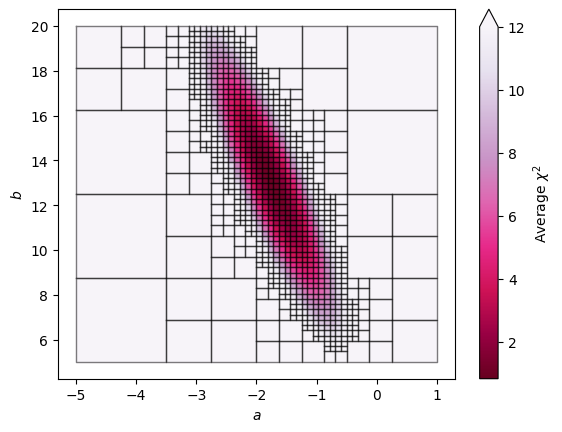
Grid-based approach to model optimization.
E.g., plotting \(\chi^2\) as a function of two model parameters.
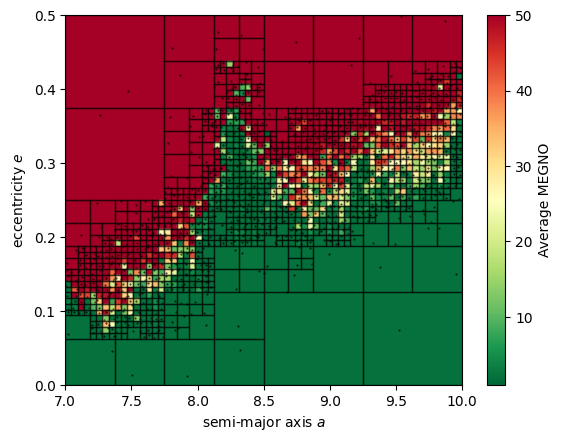
N-body simulation grids.
E.g., MEGNO as a function of two orbital elements.
Pipeline sensitivity maps.
E.g., Exoplanet transit injection/recovery tests as a function of \(R_p/R_*\) and period.
Note
astroQTpy is a living project that will be continually updated and upgraded over time. Check back for updates
or feel free to give us suggestions! (You can also define your own astroQTpy class – check out the tutorials for more info!)
Attribution:
If you use
astroQTpyin your work, please cite our Zenodo:
@software{harada_astroQTpy_2023,
   author       = {Caleb K. Harada},
   title        = {astroQTpy},
   month        = July,
   year         = 2023,
   publisher    = {Zenodo},
   version      = {},
   doi          = {10.5281/zenodo.8190984},
   url          = {https://doi.org/10.5281/zenodo.8190984}
}
If you use REBOUND or any of dependencies, please also cite those. The simplest way to find the citations relevant to the specific setup of your
REBOUNDsimulation is:
sim = rebound.Simulation()
-your setup-
sim.cite()
User Guide:
Changelog:
0.1.3 (2023-07-28)
New tutorials, update docs, etc. (@CalebHarada)
0.1.2 (2023-07-27)
Update docs, etc. (@CalebHarada)
0.1.1 (2023-07-26)
First release on Zenodo (@CalebHarada)